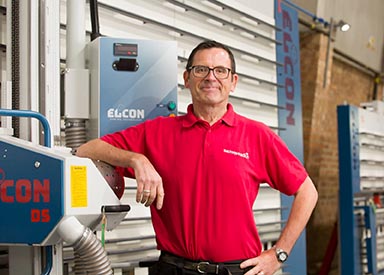
IN MARCH, I will retire after 43 years in the woodworking and manufacturing industry.
That sentence still feels strange to write.
My career began in 1983, straight out of school, as a wood machining apprentice. Like many of my generation, I learned my trade the traditional way: hands-on, on the shop floor, surrounded by experienced machinists who passed knowledge down through repetition, observation, and correction.
Over the decades that followed, I worked across joinery shops, specialist manufacturers, the Ministry of Defence (which I can’t say a lot about), the prison service (which I talk more about later), point-of-sale production, and eventually into training roles that would take me across the UK, Ireland, and beyond.
Now, as I prepare to step away, it feels like I’ve come full circle — from apprentice to trainer — at a time when the industry is facing one of its biggest challenges: the loss of skills.
I didn’t set out to work in training. That shift came later in my career, during an unexpected chapter in the prison service. I joined initially as a discipline officer before moving into workshop instruction, where the focus was on delivering technical qualifications to offenders preparing for release.
It was a challenging environment, but also an eye-opening one. You quickly learn that training isn’t about manuals or checklists. It’s about communication, patience, adaptability, and understanding how different people learn, particularly those with additional needs or low confidence.
That experience sparked something in me. It showed me that teaching practical skills, done properly, can genuinely change outcomes. When I later moved into industrial training roles, those lessons came with me, and they still shape how I approach training today.
One of the biggest changes I’ve seen over four decades is the disappearance of formal training routes. When I started, wood machining courses were commonplace. Today, there are very few colleges offering them at all. Funding and capacity pressures on FE colleges, combined with a documented fall in engineering and manufacturing apprenticeships and a contraction in technical and vocational providers, have led to an increasing difficulty in sustaining workshop-based, machinery-intensive training in general. That means manufacturers can no longer rely on “ready-made” operators arriving with baseline skills. At the same time, machinery has become more advanced, more automated, and, crucially, higher risk if used incorrectly.
Training is no longer just about compliance. It’s about productivity, safety, retention, and protecting investment. In my experience, done well, it’s becoming a competitive advantage.
The decline in formal education routes is only part of the picture. Even where businesses recognise the need to train, there are real pressures holding them back. A 2025 “Skills for Success” report for engineering and manufacturing notes that average employer spending on training has dropped by around 27% since 2011, while public funding for adult skills fell by about 31% from its early-2000s peak, contributing to reduced workplace training days. This is supported by Government data which shows there has been a “notable decrease in participation rates and expenditure” on formal training, with employers citing cost pressures and difficulties releasing staff.
Our industry isn’t an outlier with the challenges it faces. Production targets are tight, margins are under strain, and training is still too often seen as downtime rather than investment. In some cases, there’s a fear that investing in people only makes them more attractive to competitors. In others, there’s simply a lack of time, structure, or internal expertise to deliver training properly. The result is that training becomes reactive rather than strategic — delivered after something goes wrong, instead of before it does.
Over the years, I’ve delivered training to hundreds of businesses — from two-person joinery shops to expansive teams behind global names like Dyson, Bentley, and Land Rover. The common thread across all of them is the same: the companies that invest in proper training get more from their people and their machines.
Spending years on the road gives you a unique perspective on what really happens on shop floors. One thing leaders often underestimate is how quickly bad habits creep in when training is treated as a one-off event. I’ve seen excellent machines underperform because only one person truly understands them. I’ve seen productivity suffer because processes aren’t consistent. And I’ve seen safety risks increase when experience is assumed rather than refreshed.
One of the most common assumptions I encounter is that experience automatically equals competence. Operators are expected to “pick things up” because they’ve been around machinery for years. But without consistent reinforcement, bad habits form quietly. Knowledge becomes siloed with one individual, and when that person is absent, productivity and safety both suffer.
Good training doesn’t remove responsibility from operators — it gives them clarity, consistency, and confidence in what’s expected. The best workshops aren’t necessarily the biggest, or the most automated. They’re the ones where training is ongoing, standards are reinforced, and people feel supported rather than rushed.
While my background is in woodworking, one of the most interesting shifts I’ve seen is how transferable those core principles have become. Modern workshops often process plastics, composites, insulation boards, and aluminium alongside timber.
Despite the materials changing, the fundamentals don’t. Safe setting, safe operation, and understanding machine behaviour apply whether you’re cutting wood, steel, or Perspex. That opens up real opportunities for cross-skilling teams and future-proofing the workforce, provided the training is done properly.
Over the past few years, I’ve been proud to be part of Daltons Wadkin’s training team — known internally as the “Red Team”. What started as a small function has grown into a dedicated, five-strong team delivering nationwide, PIABC-assured training around the globe.
That growth didn’t happen by accident. It reflects a wider industry shift. Many manufacturers no longer have in-house maintenance or training capability, and demand for expert, practical support has increased as machinery becomes more complex.
What I’ve learned is that training works best when it’s treated as an ongoing capability rather than a tick-box exercise. When it’s embedded into how a business operates — alongside service, maintenance, and support — it becomes part of the culture rather than a one-off event.
As I look ahead to retirement, I feel incredibly fortunate. I’ve worked in an industry full of skilled, passionate people, and I’ve had the chance to pass knowledge on rather than just accumulate it. Machines will continue to evolve. Automation will improve. Software will get smarter. But none of it works without people who understand what they’re doing and why they’re doing it.
The risk for manufacturers is assuming this problem will resolve itself. Skills don’t regenerate automatically, and neither does experience. Without deliberate investment, businesses risk owning increasingly sophisticated machinery without the in-house capability to run it safely, efficiently, or consistently. Over time, that gap shows up in downtime, quality issues, and lost confidence on the shop floor. After 43 years, that’s the lesson I’ll take with me: the future of manufacturing won’t be defined by the machines we buy, but by the skills we invest in. That, and how seriously we take the responsibility of developing them.
See page 15 of our February/March 2026 issue on our Back Issues page.
Daltons Wadkin: www.daltonsmachines.com